Showing posts with label Breviary. Show all posts

Friday, March 22, 2013

Love Surpassing the Power of Human Telling


Second Station of the Cross, Jerusalem.
          Bend thy boughs, O tree of glory!
          Thy too rigid sinews bend;
          For awhile the ancient rigor
          That thy birth bestowed, suspend;
          And the King of heavenly beauty
          On thy bosom gently tend!
-4th Verse of Lustris sex qui jam peractis,
Passiontide Hymn of Lauds

The Christian life is very much about bending our stiffened boughs and letting humility restore suppleness to the sinews of our inner being and opening us to Love.

As we go through Passiontide and into Holy Week, the antiphons, chapters, and versicles of the Divine Office continue to work away at our callousness. For Terce on Palm Sunday, we hear this little chapter, which stays with us in an abbreviated form through Wednesday of Holy Week:

My brothers, have among yourselves the same mind as Christ Jesus: though by nature He was God, He did not consider His equality with God a condition to be clung to, but emptied Himself by taking the nature of a slave, fashioned in the likeness of men, and recognized by outward appearance as man.

The little chapter for the second nocturn of Vigils for Monday through Wednesday will pick up the same theme:


    Christ humbled Himself and became obedient to death, even the death of the cross.


Hymns and chapters disappear for the office of the Triduum, but this piece stays with us, growing over each of the three days.

On Thursday at the end of Lauds we sing, “Christ, for our sake, became obedient unto death.” On Friday, we add, “Even the death of the cross.” Saturday concludes with, “Wherefore God also has highly exalted him, and given him a name which is above every name.”

Repetition and addition wear away at complacency. The texts of Passiontide do their work, recounting the Savior’s sufferings as he speaks to us in the versicles recounting his days as the Man of Sorrows. After his abandonment and suffering have sunk in, the office of the Triddum gives us this one thought for three days: Christ, who was God, humbled and emptied himself and accepted a common criminal’s death in agony and shame for our sake in perfect selflessness and love.

What more could soften our hearts and rebuke our pride? What have we accomplished or done that could ever match this? What hurt or slight is so severe that we can turn our eyes away from the Savior’s example of love perfected in humility and humility perfected by love?


For awhile the ancient rigor
That thy birth bestowed, suspend;
And the King of heavenly beauty
On thy bosom gently tend!


For these days, we tend that broken body and are filled again with love for Love incarnate. In the annual retelling of the Romance of the Passion, we relive the doubt, separation, horror, and loss and, when our hearts have been broken so that there is once again room for Him to enter, we receive our heart’s desire anew at the empty tomb.

Easter and Pentecost will call us beyond this intimacy to practice our new-found love with those less lovely, just as they must do with us. Next year we will need this week again and again the texts will do their work to remake our hearts if we let them. Frederick Littledale’s translation of Bianco da Siena’s hymn to the Holy Spirit captures both the ardor and the need, which we can almost lose in the beauty of the Vaughn Williams tune:


    Come down, O love divine,
    seek thou this soul of mine,
    and visit it with thine own ardor glowing;
    O Comforter, draw near,
    within my heart appear,
    and kindle it, thy holy flame bestowing.

    O let it freely burn,
    till earthly passions turn
    to dust and ashes in its heat consuming;
    and let thy glorious light
    shine ever on my sight,
    and clothe me round, the while my path illuming.

    Let holy charity
    mine outward vesture be,
    and lowliness become mine inner clothing;
    true lowliness of heart,
    which takes the humbler part,
    and o'er its own shortcomings weeps with loathing.

    And so the yearning strong,
    with which the soul will long,
    shall far outpass the power of human telling;
    for none can guess its grace,
    till Love create a place
    wherein the Holy Spirit makes a dwelling.

Thursday, September 13, 2012

Remembering Canon Offerle


The Rev'd Canon Robert Warren Offerle, CSSS
Today is the year’s mind of the finest priest I ever knew.  He smoked cigarillos, drank cheap light beer, gloried in his collection of bad cuff links, and, more than once, I thought I might kill him before we got home when we went to West Africa together.  He had a stutter and a limp. He was The Rev. Canon Robert Warren Offerle.

He spent most of his life in unglamorous places doing the right thing.  He went to Namibia for five years after college as secretary to the local bishop and was eventually kicked out of the country for he and his fellow clerics’ resistance to Apartheid.  He did stints in Haiti and Panama and spent years in working class parishes in the US and working with the poor.  He was a man of strong theological opinions, but got on well with everyone, put people at ease, and had a tremendous sense of humor.

Canon Offerle didn’t earn my respect because of the things he had done, but because of his motivation for doing them.  I knew when I walked into my old parish in Philadelphia for Evensong that I would find him in his stall, saying his rosary and making his daily meditation before the Blessed Sacrament.  I knew he had said all of the previous Breviary Offices of the day, had offered Mass, and would end the day with Compline. Prayer came first, no ifs, ands, or buts.  His advice on mental prayer was, “Just talk to Him.  He wants to hear, even though he already knows, then listen.”

His commitment to standing with those in need grew out of his faith, not out of his politics.  He certainly had a politics, but he never confused it with the mystery of the Incarnation.  I learned more from him about being a priest over breakfasts after daily Mass at Pete’s Diner than I ever learned in seminary.  For all his earthiness, quirks, bad puns, and wicked gift for mimicry, he was a genuinely holy man.

Pray for me today, Father, as I shall pray for you, until we meet again.

Saturday, September 8, 2012

The Nativity of the Blessed Virgin Mary

High Altar, St. Mary's Ridge, WI.
O Mystery of Holy Church!
To Christ we sing our hymn of praise,
The Word, the Father’s only Son,
Of woman born in earthly days.

Alone among all women born
God saw thee fit to bear His Son,
Worthy to carry in thy womb
The Lord of all, the Holy One.

Come forth, sweet daughter of thy race,
O little branch, thy beauty show;
A noble blossom shalt thou bear,
Christ, God above and man below.

Lo, as the years of time go by,
We keep the day that marks thy birth,
When, sprung from an illustrious stem,
Thou first didst shine upon the earth.

Earthbound, but now and thanks to thee
Freemen of heaven too, we’re brought
Into a noble peace with God
By means out-reaching human thought.

O Lord, to Thee be glory given,
Whom once the Virgin Mother
bore; * To Father with the Holy Ghost
Be glory now and evermore. Amen.

Mysterium ecclesiae (O Mystery of Holy Church)
Hymn of Vigils for the Nativity of the Blessed Virgin Mary


Tapestry from Strausbourg, circa 1500, The Cloisters, New York.


From a Sermon by St. Peter Damian:

Beloved, the birthday of the pure and most blessed Mother of God brings us a special and indeed unparalleled joy, for the good reason that her birth marked the beginning of all human salvation.

In a way impossible to express, almighty God knew, even before human beings were created, that they would perish through the machinations of the devil, but, again before the ages began, his infinite love also formed a plan for their redemption. Not only did he decide, as part of this infinitely wise plan, the manner and order of redemption; he also determined beforehand the moment in time when he would carry out his plan.

Accordingly, just as the Son of God had to be born of the Virgin if the human race was to be redeemed, so also it was necessary for the Virgin to be born through whom the Word was to become flesh. The bridal chamber had first to be constructed that would receive the bridegroom as he came for his marriage with holy Church, the bridegroom for whom David with spiritual joy sang the wedding song that described the Lord as a bridegroom coming from his wedding chamber.

Rightly, then, is the whole earth filled with joyous exultation today; rightly does the entire holy Church sing songs ofpraise at the birth of the Mother of her Spouse. Let us therefore rejoice, beloved, on this day on which we pay homage to the birth of the blessed Virgin and celebrate the beginning of all the feasts of the New Covenant. If Solomon and the Israelites celebrated with great solemnity such a rich and magnificent sacrifice for the dedication of a temple made of stone, how great and intense should be the joy of the Christian people at the birth of the Virgin Mary, into whose womb, as into the holiest of temples, God himself deigned to descend, there to take human nature from her and dwell visibly with human beings! For while we must believe that God indeed descended into Solomon's temple, in a far more wonderful and fruitful way did he deign to abide for our sake in this spiritual sanctuary, that is, the womb of the blessed Virgin, in which the Word became flesh and dwelt among us.

Altar of St. Anne, Clermont Cathedral.

TODAY is born the Blessed Virgin Mary of the lineage of David: * By whom the salvation of the world has appeared to them that believe: whose glorious life has given light unto the world.

V. Let us joyfully celebrate teh Nativity of the Blessed Virgin Mary.

* By whom the salvation of the world has appeared to them that believe: whose glorious life has given light unto the world.

V. Glory be to the Father and to the Son and to the Holy Spirit.

* By whom the salvation of the world has appeared to them that believe: whose glorious life has given light unto the world.

-Responsory for the first nocturn of Vigils for the Nativity of the BVM

Monday, September 3, 2012

Gregory the Great: Doctor of the Church and Apostle of the English

Apostle of the English, thou
Art comrade of the Angels now:
O help the faithful, Gregory,
Who heardest then the people’s cry.

Abundant wealth was naught to thee
Who, seeking princely penury,
Did spurn the glory of the earth
To follow Jesus in His dearth.

Like some poor needy shipwrecked soul,
His messenger besought a dole;
Twin gift did thou give; nothing loth,
To offer self and silver both.

First in his Church from that time forth
Christ set thee in thy proven worth;
So did thou rise to Peter’s throne,
Whose life was pattern for thine own.

O Priest and Leader of the flock,
The Church’s glory, light, and rock,
Instructed by thy wise command,
Let not the sheep in peril stand.

Praise to the unbegotten One,
And glory to His only Son;
And thine, O Spirit, Breath of God,
Be equal majesty and laud.
Amen.

Anglorum jam Apostolus (Apostle of the English)
Hymn of Vigils for St. Gregory the Great
Composed by St. Peter Damian

Sunday, September 2, 2012

Gregory the Great: The Namesake of Chant

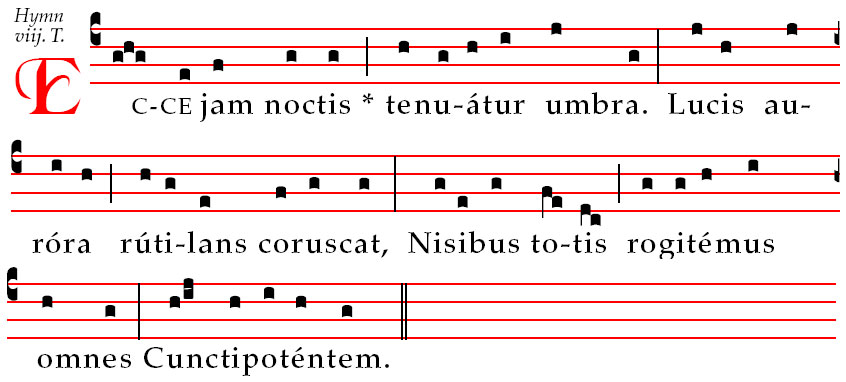
Tomorrow is the feast of Pope St. Gregory the Great, name sake of Gregorian chant.  The chant neumes were standardized and propagated long after his death, but Gregory, to whom many compositions are ascribed, is remembered as its father for his attempts to improve and standardize church music.

Ecce jam noctis, a Lauds hymn, is one of those pieces traditionally attributed to Gregory


Deus nostri miserátus, omnem
Pellat languórem, tríbuat salútem,
Donet et nobis pietáte Patris
Regna polórum.

Præstet hoc nobis Déitas beáta
Patris, ac Nati, paritérque sancti
Spíritus, cujus résonat per omnem
Glória mundum.
Amen.

* * *

Lo! the dim shadows of the night are waning;
Radiantly glowing, dawn of day returneth;
Fervent in spirit, to the mighty Father
Pray we devoutly.

So shall our Maker, of His Great compassion,
Banish all sickness, kindly health bestowing;
And may He grant us, of a father’s goodness,
Mansions in heaven.

This He vouchsafe us, God forever blessed,
Father eternal, Son, and Holy Spirit,
Whose is the glory which through all creation
Ever resoundeth. Amen.

Ecce jam noctis has a very pleasant tune to carry along the very to-the-point (and proper) morning sentiments. I am particularly struck by "Fervent in spirit, to the mighty Father, pray we devoutly." This is a good morning reminder for any of us as our mind and will wanders during the day. "Fervent" and "devoutly" remind us that the Christian's core business is seeking God, not worrying about what's left to do on our desk or what we wish we had done. Fervent: with warmth and passion. Devoutly: with humble awareness of our relationship to the God who was and is and will be.

Friday, August 24, 2012

The Feast of St. Bartholomew

The Tomb of St. Bartholomew, San Bartolomeo all'Isola, Rome.
 And Philip found Nathanael, and told him, We have discovered who it was Moses wrote of in his law, and the prophets too; it is Jesus the son of Joseph, from Nazareth. When Nathanael asked him, Can anything that is good come from Nazareth? Philip said, Come and see. Jesus saw Nathanael coming towards him, and said of him, Here comes one who belongs to the true Israel; there is no falsehood in him. How do you know me? Nathanael asked; and Jesus answered him, I saw you when you were under the fig-tree, before Philip called you. Then Nathanael answered him, You, Master, are the Son of God, you are the King of Israel. Jesus answered, What, believe because I told you that I saw you under the fig-tree? You shall see greater things than that. And he said to him Believe me when I tell you this; you will see heaven opening, and the angels of God going up and coming down upon the Son of Man. John 1:45-51

The eternal gifts of Christ the King,
The apostles’ glory, let us sing,
Ad all, with hearts of gladness, raise
Due hymns of thankful love and praise.

For they the Church’s princes are,
Triumphant leaders in the war,
In heavenly courts a warrior band,
True lights to lighten every land.

Theirs is the steadfast faith of saints,
And hope that never yields nor faints;
And love of Christ in perfect glow
That lays the prince of this world low.

In them the Father’s glory shone,
In them the will of God the Son,
In them exults the Holy Ghost,
Through them rejoice the heavenly host.

To thee, Redeemer, now we cry,
That thou wouldst join to them on high
Thy servants, who this grace implore,
For ever and for evermore. Amen.

Aeterna Christi Munera (The Eternal gifts of Christ the King)
Hymn for Vigils of an Apostle

Monday, August 20, 2012

St. Bernard of Clairvaux

The Virgin feeds St. Bernard from her breast.
Today is the Feast of St. Bernard of Clairvaux, one of the political and theological heavy-hitters of the Middle Ages, who counseled popes and kings and whose preaching and writing earned him the title of The Mellifluous Doctor. It is hard to know what to say of a saint so gifted and complex as St. Bernard, so I'll leave it to the older edition of the Cistercian Menology, where several other great saints of his era weigh in:
The feast of our very glorious Father St. Bernard, first Abbot of Clairvaux. Of noble birth, at the age of twenty-two, he succeeded in bringing to follow Christ thirty associates whom he led to Citeaux. In the Cloister his fasts, vigils and prayers were marvellous, and his life therein all heavenly. Soon, in spite of his youth, he was sent to Clairvaux. While assiduous about his own perfection, he labored zealously and successfully for the sanctification of those committed to his care. But circumstances compelled him to leave his solitude. He advises Popes, pacifices kings, converts the people, puts and end to the schism, crushes heresy, preaches the Crusades, refuses Bishoprics, works countless miracles, writes inestimable works, and when he dies at the age of 63, 160

Wednesday, August 15, 2012

The Feast of the Assumption


Our Lady as Queen of Heaven, Santa Maria in Trastevere, Rome.


Christ * ascended to the highest heaven, * where He prepared for His most pure Mother an incorruptible dwelling. * Today’s feast is incomparably greater than the feasts of all other saints. * The angelic choirs of heaven’s courts look on in amazement * as Mary, filled with bliss and glory, * enters heaven for the celebration of the divine espousals. * From heaven may Mary, in her love and goodness, * think evermore of us, who think of her.

-Antiphon for I Vespers of the Assumption from the Cistercian Breviary.
 

Assumption banner, St. Michael's, Ghent.

O with what glorious luster thou shinest,
Daughter of royalty, David’s descendant!
Throned in majesty, Mary the Virgin,
Now midst the blessed one, sitting exalted.

Joining with motherhood virginal honour,
Holy and spotless ,one, chastely thou gavest
Shrine for the heaven-sent Lord of the Angels;
Thus in humanity God was incarnate:

Whom the whole universe lowly adoreth,
Bending the knee to him meetly in homage:
On this thy holy day pray him to grant us
Light and felicity, darkness dispelling.

This of thy clemency, Father of glory,
Grant through thy Son, who, with thee and the Spirit,
In the bright firmament liveth and reigneth,
Evermore ruling and ordering all things. Amen.

O quam glorifica (Maid, who mantled in the sun)
Hymn of Vespers for the Assumption


Assumption image on the high altar in Argeles-sur-Mer.

Friday, August 10, 2012

The Story of St. Lawrence Told in Antiphons


Mural from the portico of the Basilica of St. Lawrence Outside the Walls.

Some days the Breviary antiphons tell a story.  Today's Feast of St. Lawrence is one of those days. Rather than betraying the Church or denying Christ in the persecution of Valerian in 258, Lawrence was roasted on a gridiron, famously saying, "I am done on this side, you can turn me over."  The antiphons take up the story as Lawrence encounters Pope Sixtus, who is being led to his execution.
Father, whither goest thou * without thy son? Holy Priest, where dost thou go without a deacon?

I do not leave thee, * my son, nor forsake thee, but a sterner struggle awaits thee for the faith of Christ.

Blessed Laurence said: The Darkness is no darkness with me, but all is as clear as the light.

They laid him * on the gridiron and stretched out his limbs: Christ’s Levite mocked those who brought fuel.

When I was asked, * I acknowledged thee to be the Lord; now that I am roasted, I give thee thanks.

The Levite Laurence, when roasted in the flames, did not deny the Lord.

Blessed Laurence prayed, saying, I thank You, Lord, for You have made me worthy to enter into Your gates.
-The Antiphons of Vigils

On the gridiron, O God, * I did not deny You. * When I was stretched over the flames, O Christ, * I bore witness to You. * You searched my heart, * You visited me by night, * You tested me, and found no wrong.

-Benedictus Antiphon
The deacon Lawrence * performed a good work; by the sign of the cross he gave sight to the blind, * and to the poor he gave the riches of the Church.


-Magnificat Antiphon for the Feast of St. Lawrence

Sunday, August 5, 2012

Our Lady of the Snow


West end of Rome's St. Mary Major.
If today were not a Sunday, the new Roman Calendar would mark the dedication of St. Mary Major, Rome's great church of the Virgin.  From the Middle Ages until 1969, this feast was kept under the title of Our Lady of the Snow in memory of the legend that the Virgin herself caused a snow to fall on August 5th on the site where the basilica should stand and that its outline was traced in the snow by Pope Liberius. The Miracle of the Snow is still commemorated at the Basilica on August 5, when a shower of white rose petals falls from the basilica's coffered ceiling. 

The legend of the miraculous snow only arose several centuries after the building of the Basilica and one Church commission had recommended that it be removed from the Breviary as early as 1741, but the legend remained in place in the annual reading until 1969.  It ran as follows:

Under the pontificate of Liberius, John, a Roman patrician, and his wife who was of an equally noble race, having no children to whom they might leave their estates, vowed their whole fortune to the Blessed Virgin Mother of God, begging her most earnestly and continually to make known to them by some means in what pious work she wished them to employ the money. The Blessed Virgin Mary graciously heard their heartfelt prayers and vows, and answered them by a miracle.