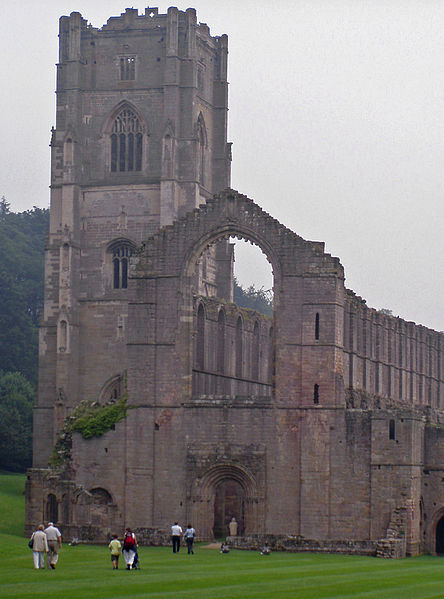
Showing posts with label Cistercian Menology. Show all posts

Thursday, May 16, 2013

Richard, First Abbot of Fountains

The ruins of Fountains.  Thanks, Henry.
It has been a while since I have run across something so long that it needed to be posted here rather than on Facebook and the end of the semester has slowed me down in general, but one of the entries in yesterday's section of the Menology was that for Richard, fist abbot of Fountains in Yorkshire.  I will draw no contemporary moral for the story, though I'm sure there is more than one to be found about perseverence in adversity, etc.  Chalk this one up to just because.

In England, Blessed Richard, first Abbot of Fountains.  He had been Prior of St. Mary’s of York when the thirst of leading a more perfect life urged him to leave that house, along with twelve associates, to follow the Rule of Citeaux.  The had the happy encouragement of our Father St. Bernard, who wrote to them stating that is was indeed easier to find a multitude of seculars converted to a good life than to witness a religious pass to a better observance.  He even sent them the Monk Geoffrey of Ainai to initiate them into our discipline.  Under his guidance, they began to build cabins, and to chant, as the old monk instructed them.  Yet, for two years, they had to suffer the hardship of of so great poverty that their food consisted in the leaves of trees and wild herbs.  Finally, as history records, the Lord multiplied the brethren and, enlarging his vineyard, shed therein the dew of his benediction, so that the monastery materially increased in possessions, and, much more, spiritually in sanctity.  Its name became very famous, and the Princes of the land revered it.  However, Blessed Richard went to receive a still better reward in Heaven, and to enjoy forever the glory merited by his labors and virtues.


Richard died at Rome while attending the Second Lateran Council. Perhaps the moral of the story is that, despite the best of intentions, one is never beyond the reach and, perhaps, allure of bureaucracy and intrigue.

Tuesday, October 16, 2012

Baldwin of Forde: Always on Crusade


Lambeth Palace, built on land bought by Baldwin of Forde.

As the Anglican world awaits the appointment of the next Archbishop of Canterbury, it is appropriate that today the Menology remembers Baldwin of Forde, who might make ++Rowan’s critics be careful what they wish for:


At Tyr, Syria, Blessed Baldwin, Abbot of Ford, in England, later on, Bishop of Exeter, and Archbishop of Canterbury, a man of power in word and work. He was a courageous defender of the rights of his Church, a very eloquent preacher, a very learned writer. He also distinguished himself by his valour in the Crusade, where, under his banner, which bore the image of St. Thomas of Canterbury, he had five hundred soldiers, at his own expense. He died in Palestine, leaving all his money to defray the expenses of the holy war.


Baldwin was not one who believed in going along to get along when he thought that principle was at stake. He excommunicated the then Prince John for a consanguineous marriage, dueled with the Chapter of Canterbury over their laxity, and died in Palestine just before he could excommunicate the Archbishop of Pisa and the Latin Patriarch of Jerusalem. One detractor said that Baldwin was worse for Christianity than Saladin.

Other than crowning Richard the Lionheart, Baldwin is perhaps best remembered for his battle with the Benedictines of Canterbury, whom he criticized for their laxity and whom he believed to be living too well from the income of the shrine of St. Thomas. Needless to say, they were none too thrilled to begin with at having a former Cistercian abbot thrust upon them over their objections. Baldwin was perhaps a bit extreme in locking them up in their cloister for better than a year.  In the end, Baldwin bought a piece of land across the Thames from Westminster to build his own collegiate church dedicated to the Cistercian St. Thomas. That plan was frustrated by his death, but Lambeth Palace stands on the site today as an indirect tribute to his persistence. I'm sure that there were good monks at Canterbury who thought that they were doing the right thing by staying the established course, but, seven centuries on, they don't come off so well while inconvenient old Baldwin remains in print in several languages.

For all of his quarrelsomeness, Baldwin also seems to have known himself and provides some salutary correction for those of us who are by temperament more ready to fight than to practice charity. In his Treatise on the Common Life, he writes,


Why do you command me not to hate my enemies, but to love them instead? How can I do this? Look, if I am provoked by the slightest insult, I catch fire inside and flare up! My heart burns for revenge, and my tongue falls headlong into abuse. For the moment, I am ignorant of God and do not know Your laws, and You say, ‘Whoever is angry with his brother shall be in danger of judgment.’ If I say to my brother, ‘Raca!’ or ‘you fool’, You frighten me even more, for I am in danger of the council or of hellfire! Surely ‘You have commanded that Your commandments be kept diligently!’

To be quite honest, I can forget the benefits, but I cannot forget the injuries. I am, by nature, such a child of wrath that it is impossible for me not to be angry! However, You, Jesus, are You angry? You who forbid me to be angry or to be the slightest bit annoyed with my enemy, or even to grumble in my heart? Where can I find the power to make my heart so stable that I will never be annoyed at all, or that maybe, as it were, insensible to all injuries? Where can we find the power to do what You want us to do and suffer what You want us to suffer unless You who gave us the laws also give us your blessing. Where can we find the power unless You come to us first with blessings of sweetness, unless we remain in the charity of Your sweetness?

In this charity all that is bitter becomes sweet and all that is hard is softened. Here alone Your yoke is sweet and your burden light. What is difficult for someone who loves? The more strictly something is imposed upon us, the easier it becomes by devotion to charity. Charity is patient, charity is strong, labor does not tire it, nor does any burden weigh it down. It bears all things, endures all things, and although it is conscious of a holy modesty, it is also, in a reverent way, shameless. It blushes at all unseemly things, but not at the words of Christ, not at the reproach of Christ, and not at the example of Christ. Christ, who added to the law its perfection, taught us what we should do, and all that He taught He fulfilled in Himself, and he gave Himself as an example.
(Source.)

Monday, October 15, 2012

Sourcing St. Gauthier: Electronic Sleuthing to Find a Medieval Wonder-Worker

The Spring of St. Gauthier (source).
Today we have one of those mystery saints for whom the Menology gives only a tantalizing brief entry:

In France, the Passion of Blessed Gouthier, twelfth Abbot of Quincy. He was eminent for his admirable virtues, and found worthy of the Martyr’s palm in 1244.

My initial searches quickly turned up the Fountain or Spring of St. Gauthier, which had once provided water to the Abbey of Quincy, founded in 1133 and located roughly midway between Troyes and Auxerre. Quincy was the sixth daughter house of Pontigny and met its end at the time of the Revolution. The Renaissance Abbot’s house and a part of what had once been a dormitory or hostel are all that remains other than the Spring of St. Gauthier with its statue, which may have come from the abbey church.

Unable to resist what sounded like the story of one of those vulgarly popular wonder-working saints too often ignored in contemporary Cistercian scholarship, I set about to dig up what I could.  Several guides recommend the spring as a romantic and mysterious site. Traditionally, its waters were regarded as particularly effective in curing eye diseases and expectant mothers were believed to be able to determine the sex of their child by drinking from its left side for a boy or its right side for a girl. The healing tradition continues in a modern form nearby, where part of the abbey’s former lands are now a plantation of English Yew grown for use in chemotherapy.

Bl. Gauthier himself proves more elusive. Various legends record him as an Irish monk who ruled the abbey for ten years before being assassinated by another monk, a death remarkably similar to that of Bl. Gerard of Clairvaux whom the Menology records on October 16. Other legends record him as a martyr, but having first become Bishop of Auxerre.

An 1887 article in the Bulletin of the Society of Historical and Natural Sciences of Lyon examines the legend of Gauthier in a discussion of the Abbe Lebeuf’s 1730 journey to Clairvaux. It points out that the only Abbot of Quincy to be found in the extant documents with the name Gauthier ruled from 1171-1172, which would have placed him near 100 years old if he had been martyred in 1244. The article also questions a tradition that Gauthier went on to be Bishop of Auxerre.

The date of 1244 also makes for an interesting date for a martyrdom. One might assume that Gauthier fell in activity against the alleged Cathars to the south, but the the Albigensian Crusade had been reduced to a mopping-up exercise by this this period and the last major fortress at Montsegur had fallen in March of 1244, leaving opportunities for martyrdom rather scarce compared to what they might have been a generation earlier. Death in more distant parts would seem unlikely since Gauthier’s tomb was a prominent feature of the abbey church.

A condensed version of the hagiography of the Bollandists from 1878 lists 16 Gauthiers, including an October 15 listing for S. Gauthier, Abbot of the Monastery of Our Lady of Quincy and Martyr and giving the alternate Latin “Gallerus.”

The Abbey suffered as greatly as its martyr, following the sad pattern of Huguenot attack, crippling centuries of commendum, and, finally, dissolution at the Revolution, when only three monks and their conventual prior remained. The property passed into private hands and the buildings fell into ruin. The ruined church was pulled down in 1855 and the remaining buildings served various functions. Today they are a gite that can be rented by the week.

The story does have a happy ending, at least as concerns the mortal remains of our illusive saint. Anticipating the near-certain looting and desecration of the abbey church, the priest of neighboring Commissey obtained permission from the civil authorities to translate the relics of St. Gauthier. On April 26, 1791, the inhabitants of Commissey and other nearby villages made their way to the church, opened the tomb, placed the saint’s relics on a hearse decked with greenery, and processed to Commissey led by an honor guard and singing hymns along the way. The relics remained exposed for the veneration of the faithful throughout the day before being placed in a new tomb in the village church.

But, since contemporary French drama frowns upon happy endings, there must be a dispiriting coda. St. Gauthier’s tomb held a place of honor in the church of Commissey until 1847, when it was pulverized and used as fill for the reconstruction of the church’s choir. His relics were interred without ceremony in a new altar.


Many questions remain unanswered by this entry, but these are the frustrating limits of doing hagiography on the fly. As Google Books continues to swallow more and more of the world’s libraries, perhaps a new clues will come to light. While I have my qualms about what will become of Google’s quest to gobble up all of the world’s libraries, my own reading would be much poorer without it. This piece’s major sources for St. Gauthier were Google-scanned copies of books at Princeton, the University of Toronto, and Harvard, which are a bit of a hike from rural Wisconsin where I drafted this piece a few years ago or from Fayetteville, where hagiography is not exactly the University library's greatest strength.  For those of you of more geeky inclinations who read French, the extensive online holdings of the Bibliothèque nationale de France 
remain outside of the search reach of Google Books.  There is a world of good stuff there on religion.  For those who like your religion a bit more folksy, the photo of the spring comes from www.oratiores.com--yes, you still need the "www" for this one--which features roadside shrines, chapels, and grottoes.

Sunday, October 14, 2012

The Venerable Claire Dullaerts, Abbess of Beaupre

The seal of the Abbey of Beaupre. (Source.
The final entry in today’s reading from the Menology concerns a wise abbess known variously as Clair, Claire, or Clara:

In Belgium, Blessed Clare, Abbess of Beaupre, near Grammont, illustrious for her love of poverty, her zeal for discipline and her miracles. Elected in 1500, she ruled her monastery forty years, and by her faith and prayers, secured for it in certain emergencies special Divine Assistance.

Several things struck me about this notable woman, the first being that she was known more for being a shepherd of her flock than a mystic or wonderworker. Some accounts say that in the time of The Venerable Claire there were more than 200 nuns at Beaupre, living in the poverty they found consistent with the rule. Abbess Claire’s miracles relate chiefly to answered prayers that saved the day when the wolf was at the door. The Cistercian mystics are generally considered to be the Order's glory, but too often the wise abbess gets lost in the glare of the spiritual pyrotechnics of her sisters.

A second interesting piece of The Venerable Claire's story is that she was a reformer. While one of her Cistercian sisters in Germany chose to embrace contemporary ideas of reform by marrying Martin Luther, Claire and her house set an example of living the rule in the best manner they could manage. (Not many years after her death, the wars of religion forced the community to withdraw from the house and seek shelter in Grammont for nine years.) In a period in which, in the English-speaking world in particular, we are taught to think of traditional Christian practice as decadent and overripe, Claire and her sisters were models of the evangelical counsels.

Finally, in an age of innovation, Claire put her trust in the observance of the Rule of St. Benedict. As the learning of the Renaissance flooded Europe, putting all settled ideas up for debate, Claire seemed to remain certain that there was value in the lived experience of the past rather than only in its newly rediscovered abstractions. One French snippet of a biography I found said that she was chosen abbess for her vigilance and that she would not compromise observance in the slightest, but that she acted with perfect humility.

An artist's reconstruction of Beaupre. (Source.)

After peace returned to the region, Beaupre seems to have enjoyed a rather long period of tranquility before being swept away by the aftermath of the French Revolution, and so this entry too ends as these entries so often do. Venerable Claire, pray that we see the value in fidelity when we are tempted by novelty for novelty’s sake.

Monday, August 20, 2012

St. Bernard of Clairvaux

The Virgin feeds St. Bernard from her breast.
Today is the Feast of St. Bernard of Clairvaux, one of the political and theological heavy-hitters of the Middle Ages, who counseled popes and kings and whose preaching and writing earned him the title of The Mellifluous Doctor. It is hard to know what to say of a saint so gifted and complex as St. Bernard, so I'll leave it to the older edition of the Cistercian Menology, where several other great saints of his era weigh in:
The feast of our very glorious Father St. Bernard, first Abbot of Clairvaux. Of noble birth, at the age of twenty-two, he succeeded in bringing to follow Christ thirty associates whom he led to Citeaux. In the Cloister his fasts, vigils and prayers were marvellous, and his life therein all heavenly. Soon, in spite of his youth, he was sent to Clairvaux. While assiduous about his own perfection, he labored zealously and successfully for the sanctification of those committed to his care. But circumstances compelled him to leave his solitude. He advises Popes, pacifices kings, converts the people, puts and end to the schism, crushes heresy, preaches the Crusades, refuses Bishoprics, works countless miracles, writes inestimable works, and when he dies at the age of 63, 160