Saturday, September 8, 2012

The Nativity of the Blessed Virgin Mary

High Altar, St. Mary's Ridge, WI.
O Mystery of Holy Church!
To Christ we sing our hymn of praise,
The Word, the Father’s only Son,
Of woman born in earthly days.

Alone among all women born
God saw thee fit to bear His Son,
Worthy to carry in thy womb
The Lord of all, the Holy One.

Come forth, sweet daughter of thy race,
O little branch, thy beauty show;
A noble blossom shalt thou bear,
Christ, God above and man below.

Lo, as the years of time go by,
We keep the day that marks thy birth,
When, sprung from an illustrious stem,
Thou first didst shine upon the earth.

Earthbound, but now and thanks to thee
Freemen of heaven too, we’re brought
Into a noble peace with God
By means out-reaching human thought.

O Lord, to Thee be glory given,
Whom once the Virgin Mother
bore; * To Father with the Holy Ghost
Be glory now and evermore. Amen.

Mysterium ecclesiae (O Mystery of Holy Church)
Hymn of Vigils for the Nativity of the Blessed Virgin Mary


Tapestry from Strausbourg, circa 1500, The Cloisters, New York.


From a Sermon by St. Peter Damian:

Beloved, the birthday of the pure and most blessed Mother of God brings us a special and indeed unparalleled joy, for the good reason that her birth marked the beginning of all human salvation.

In a way impossible to express, almighty God knew, even before human beings were created, that they would perish through the machinations of the devil, but, again before the ages began, his infinite love also formed a plan for their redemption. Not only did he decide, as part of this infinitely wise plan, the manner and order of redemption; he also determined beforehand the moment in time when he would carry out his plan.

Accordingly, just as the Son of God had to be born of the Virgin if the human race was to be redeemed, so also it was necessary for the Virgin to be born through whom the Word was to become flesh. The bridal chamber had first to be constructed that would receive the bridegroom as he came for his marriage with holy Church, the bridegroom for whom David with spiritual joy sang the wedding song that described the Lord as a bridegroom coming from his wedding chamber.

Rightly, then, is the whole earth filled with joyous exultation today; rightly does the entire holy Church sing songs ofpraise at the birth of the Mother of her Spouse. Let us therefore rejoice, beloved, on this day on which we pay homage to the birth of the blessed Virgin and celebrate the beginning of all the feasts of the New Covenant. If Solomon and the Israelites celebrated with great solemnity such a rich and magnificent sacrifice for the dedication of a temple made of stone, how great and intense should be the joy of the Christian people at the birth of the Virgin Mary, into whose womb, as into the holiest of temples, God himself deigned to descend, there to take human nature from her and dwell visibly with human beings! For while we must believe that God indeed descended into Solomon's temple, in a far more wonderful and fruitful way did he deign to abide for our sake in this spiritual sanctuary, that is, the womb of the blessed Virgin, in which the Word became flesh and dwelt among us.

Altar of St. Anne, Clermont Cathedral.

TODAY is born the Blessed Virgin Mary of the lineage of David: * By whom the salvation of the world has appeared to them that believe: whose glorious life has given light unto the world.

V. Let us joyfully celebrate teh Nativity of the Blessed Virgin Mary.

* By whom the salvation of the world has appeared to them that believe: whose glorious life has given light unto the world.

V. Glory be to the Father and to the Son and to the Holy Spirit.

* By whom the salvation of the world has appeared to them that believe: whose glorious life has given light unto the world.

-Responsory for the first nocturn of Vigils for the Nativity of the BVM

Friday, September 7, 2012

The Holy Shroud of Cadouin: Always Read the Manufacturer's Label

Boss showing the Sacred Bandage at the Abbey of Cadouin.


As was the case yesterday with San Ero, tomorrow's reading from the 19th Century edition of the Cistercian Menology takes us to another stop along the pilgrimage route to Compostela, this time in further north in France:

At Cadouin, Perigord, the exposition of the Sacred Bandage which, in the tomb covered the Sacred Head of our Lord jesus Christ. Adhimar of Monteil, Bishop of Puy, Legate of the Holy See, discovered it at Antioch in 1098. At his death, he entrusted it to a Priest companion. The Canons were incredulous, and the Priest returned to Perigord with the precious Relic. Preserved in a conflagration by the Monks of Cadouin, it remained with them, and was the center of one of the most celebrated devotions of the middle ages. The Abbey Church became parochial the Feast [was] fixed for the Tuesday after the Exaltation of the Holy Cross, and it is annually celebrated by an immense number of the devout Faithful.


The cloister at Cadouin.

The Lincieul de Cadouin or the Saint Suaire made the Abbey a major stop for pilgrims heading south and the abbey grew quite wealthy. When the original cloister collapsed in the 15th Century, it was rebuilt in Flamboyant style. Today the abbey complex is a UNESCO World Heritage site.


An early 20th Century procession of the Saint Suaire.


After the suppression of the abbey, the pilgrimage continued until 1934, when a photo of the shroud was shown to the director of Cairo’s Coptic Museum, who noticed that the banding contained a familiar script. The inscription read in part, “Mohamed is the prophet of God and Ali is God’s friend,” a standard Shiite Muslim invocation. It went on to say that the shawl had been created for the vizier of the Caliph of Cairo who had battled the Crusaders at Antioch in 1098.


The Saint Suaire.

After this, the pilgrimage ended, but the Saint Suaire remains preserved at Cadouin, the house it built. And the more than 2,000 miracles attributed to the Saint Suaire over the course of more than eight centuries remain a testament to the faith along the pilgrim route. Faith and prayer are never wasted.

Wednesday, September 5, 2012

San Ero of Armentiera: Medieval Time Traveler

San Ero, looking a bit too Franciscan.
Visions, healings, prophecy, and even levitation are all fairly common among the stories of the saints and blesseds, but, over the long weekend, we missed one of my favorites, San Ero of Armentiera, a Medieval Spanish time traveler.  

Too often theologians like to remember the great treatise writers of the Middle Ages without fully acknowledging that these men and women lived side by side with the cult of wonders.  Many folks seem more than a bit embarrassed by these saints and their legends.  I love them and think they often have as much to tell us about the Middle Ages and ourselves as the more learned works that have stayed in print.

Here's what the Cistercian Menology says of St. Ero:

In Galicia, Spain, Blessed Ero, Abbot of Armentiera, eminent in purtiry and holiness. He was of noble birth, and founded this Monastery in the family domain. As he was very meditative, one day, contemplating the happiness of Heaven, as related, he asked himself if weariness could be found therein. He was then in a wood nearby. A beautiful bird began to flutter around him bringing ravishing melodies to his ear, so that he remained as he thought a quarter of an hour listening to it. Then he returned to the Monastery. But here, men and things were much changed; astonishing above all was that in the Monastery which he had placed under Clairvaux on the 3rd of the Calends of Autust 1162, as authentic charts testified, he found himself in the year 1367. The Monks shared his amazement and showed him every kind of attention. Then soon after, fortified with the sacraments of the Church, in the midst of the Monks, who were celebrating the marvels of God, he departed this life, and fearing no weariness, flew to hear the Angels’ chants for ever.

Other sources record that St. Ero was a childless knight in the court of Alphonso VII, who was told in a dream by the Virgin to found an abbey and beget spiritual children. A variant of his legend is recorded in 103rd of the Cantigas de Santa Maria, a collection of 420 poems in praise of the Virgin collected during the reign of Alphonso X. I don't think it's overly impious to say that the reappearance of San Ero might also have provided a welcome boost in pilgrim traffic to Armentiera, which lies near Santiago de Compostela.  Whatever its source, the story of San Ero provides a beautiful meditation on time, eternity, and contemplation.

The Abbey of Santa Maria de Armentiera.
 The Abbey of Santa Maria de Armenteira was secularized in 1835 and its lands, like those of many Spanish monasteries, were liquidated to benefit the state. The buildings were restored beginning in 1961 and a community of Trappistine nuns resumed life there in 1989.

Visit the website of Santa Maria de Armenteira.>>>

Tuesday, September 4, 2012

ISM Tuesday Net Round Up

Detail from the cloister of Elne.
Several new pieces from around the Independent Sacramental Movement came on line in the last week.

First from, the Independent Catholic Christian Church, the bloggingest jurisdiction in Christendom, we have:

Looking Evil in the Eye: Sermon Preached at the Ordination of Br. Shane Neese, AIHM, to the Order of Exorcist, August 11, 2012

Fr. Joseph Augustine offers his thoughts on being Joyfully Sacramental.


Theology Schmeology offers a guest sermon for Proper 14 given at Philadelphia’s St. Mary of Grace on Chick-fil-A and what Jesus would do.

Finding Grace in Ordinary time reflected on the Solemnity of St. Augustine and community at a distance.

Around the rest of the ISM:

The Vagrant Vicar says we should be less worried about respectabity in Judge Not.

Rumney Marsh Ruminations ponders death and bereavement in Reflecting All Over the Map.

Finally, just up the road in the Ozarks, Abbot-Bishop Brian E. Brown announces the return of Radio Free Catholic.

Monday, September 3, 2012

Gregory the Great: Doctor of the Church and Apostle of the English

Apostle of the English, thou
Art comrade of the Angels now:
O help the faithful, Gregory,
Who heardest then the people’s cry.

Abundant wealth was naught to thee
Who, seeking princely penury,
Did spurn the glory of the earth
To follow Jesus in His dearth.

Like some poor needy shipwrecked soul,
His messenger besought a dole;
Twin gift did thou give; nothing loth,
To offer self and silver both.

First in his Church from that time forth
Christ set thee in thy proven worth;
So did thou rise to Peter’s throne,
Whose life was pattern for thine own.

O Priest and Leader of the flock,
The Church’s glory, light, and rock,
Instructed by thy wise command,
Let not the sheep in peril stand.

Praise to the unbegotten One,
And glory to His only Son;
And thine, O Spirit, Breath of God,
Be equal majesty and laud.
Amen.

Anglorum jam Apostolus (Apostle of the English)
Hymn of Vigils for St. Gregory the Great
Composed by St. Peter Damian

Sunday, September 2, 2012

Gregory the Great: The Namesake of Chant

Tomorrow is the feast of Pope St. Gregory the Great, name sake of Gregorian chant.  The chant neumes were standardized and propagated long after his death, but Gregory, to whom many compositions are ascribed, is remembered as its father for his attempts to improve and standardize church music.

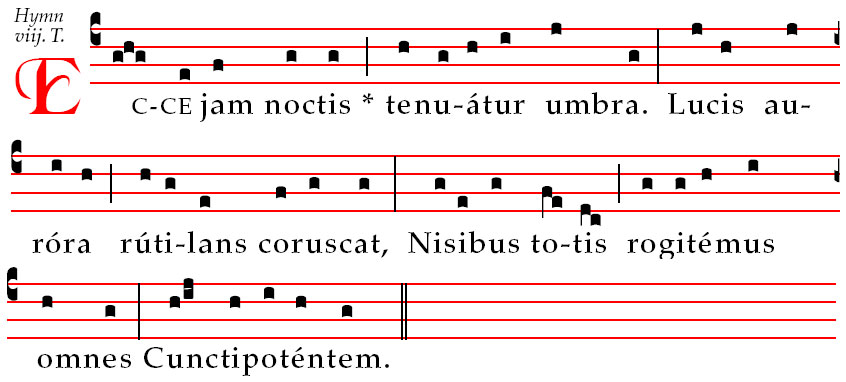
Ecce jam noctis, a Lauds hymn, is one of those pieces traditionally attributed to Gregory


Deus nostri miserátus, omnem
Pellat languórem, tríbuat salútem,
Donet et nobis pietáte Patris
Regna polórum.

Præstet hoc nobis Déitas beáta
Patris, ac Nati, paritérque sancti
Spíritus, cujus résonat per omnem
Glória mundum.
Amen.

* * *

Lo! the dim shadows of the night are waning;
Radiantly glowing, dawn of day returneth;
Fervent in spirit, to the mighty Father
Pray we devoutly.

So shall our Maker, of His Great compassion,
Banish all sickness, kindly health bestowing;
And may He grant us, of a father’s goodness,
Mansions in heaven.

This He vouchsafe us, God forever blessed,
Father eternal, Son, and Holy Spirit,
Whose is the glory which through all creation
Ever resoundeth. Amen.

Ecce jam noctis has a very pleasant tune to carry along the very to-the-point (and proper) morning sentiments. I am particularly struck by "Fervent in spirit, to the mighty Father, pray we devoutly." This is a good morning reminder for any of us as our mind and will wanders during the day. "Fervent" and "devoutly" remind us that the Christian's core business is seeking God, not worrying about what's left to do on our desk or what we wish we had done. Fervent: with warmth and passion. Devoutly: with humble awareness of our relationship to the God who was and is and will be.

Saturday, September 1, 2012

The Prologue of the Rule of St. Benedict


Several sets of signposts mark out the progress of the year in liturgical time. First, there is the temporal cycle of the church year carrying us from Advent to Advent through the great feasts of our redemption, varying each year based on the date of Easter. Next comes the sanctoral cycle with all of the saints’ days fixed on their specific calendar dates. Then there is the great division of the year between liturgical summer and winter—it is only a two season year—when some rites change hymns and canticles in the Divine Office and prelates exchange silk for fur, not that we see too much of that these days.

Another constant running along with these others, but on its own course, is the reading of the Rule of St. Benedict in monasteries and among their oblates. The Rule, which is read through three times each year in daily sections, is one of the most theologically, politically, and psychologically brilliant pieces in all of Western literature.   In its pages, we are given a guide not only for the soul’s quest for God, but also for living with others and with ourselves.  On January 1, May 2, and today, the reading begins with the opening section of the prologue and its famous metaphors of the ear of the heart and the warrior armed with obedience.  It is also a sign that fall is almost here. Deo gratias.


Listen, O my son, to the precepts of thy master, and incline the ear of thy heart, and cheerfully receive and faithfully execute the admonitions of thy loving Father, that by the toil of obedience thou mayest return to Him from whom by the sloth of disobedience thou hast gone away.

To thee, therefore, my speech is now directed, who, giving up thine own will, takest up the strong and most excellent arms of obedience, to do battle for Christ the Lord, the true King.

 In the first place, beg of Him by most earnest prayer, that He perfect whatever good thou dost begin, in order that He who hath been pleased to count us in the number of His children, need never be grieved at our evil deeds. For we ought at all times so to serve Him with the good things which He hath given us, that He may not, like an angry father, disinherit his children, nor, like a dread lord, enraged at our evil deeds, hand us over to everlasting punishment as most wicked servants, who would not follow Him to glory.