Showing posts with label Bernard of Clairvaux. Show all posts

Monday, March 18, 2013

Veiling our Images: A Sermon for Passion Sunday


You may have noticed that tonight we omitted Psalm 42 in the prayers at the foot of the Altar, with its familiar “O send out thy light and thy truth that they may lead me and bring me unto thy holy hill and to thy dwelling,” only to hear this verse as the introit of the Mass.  As with most of these things, there is a message there.

Today we enter Passiontide and, in the breviary, the hymns of the first part of Lent give way to new pieces focused upon the mystery of the cross.  The hymn of the vespers, written 1400 years ago, proclaims, “The royal banners forward go.  The cross shines forth in mystic glow.”  In the epistle and in the preface, we hear of the battle of two trees:  The Tree of the Knowledge of Good and Evil, which Satan used to trick Adam and Eve into mortality and the cross, by which Christ brings the hope of life back into the world.  

The cross of Christ takes center stage as we prepare to celebrate the redemption of the world.  And yet this is precisely the day when we veil the crosses and, paradoxically, when the familiar verse, “Send out thy light and thy truth,” takes a place of special prominence within the Mass.

St. Bernard of Clairvaux tells us that the final stage of learning to love God is to give up our images of God—that we must forego the God whom we have tamed in our imagination to be able to love the God who truly is, was and will be.  In this final portion of our journey through Lent, we too must veil our images if we are to be ready to meet the risen Lord at Easter.

The crucifix veiled on the altar is a central piece of my image of God.  I bought it in Bethlehem.  It hung in my house in Philadelphia.  As a monk, it hung in my cell.  Today, I say Mass in front of it.  In years of praying with this crucifix, it has become a source of solace and focus, but there is also a danger.  It is easy to look at its familiar face as I say my prayers and to let it become a symbol of the God whom I have created in my image, the one who loves me too much to challenge me, the one whom I conform to my image rather than conforming myself into his image.

St. Bernard, of course, was not speaking of literal images, but of this danger of loving a God we have made or that we believe we have the wisdom to fully comprehend and predict.  It was the beautiful Tree of Life, we are told, that led to the fall in the garden because it became a false image of redemption and life, while it was the repugnant instrument of crucifixion that actually bore the noblest fruit.  We must give up our own images to see things as they are, to find God where he is rather than where we have convinced ourselves he ought to be. 

And so today we cover our familiar images and open the Mass by praying, “O send out thy light and thy truth that they may lead me and bring me unto thy holy hill, and to thy dwelling.”  We pray for God’s light, not to walk by our own lights.  We pray for God’s truth, not our own subtlety.  We pray not to lead, but to become vulnerable and open ourselves that we may be led.  As we symbolically give up our images, we pray that we may give up our comforting distortions to seek the one who is always seeking us.

Two weeks remain until the feast of the resurrection.  Let us take the time to veil the images we have created that we may see God clearly.  Let us notice not only where the image of God is obscured in our lives, but also where we have created veils to mute the discomfort of his presence.  Let us work to free ourselves of the God whom we have created so that our hearts are prepared to receive one who is wonderful beyond all imagining.

In the name of the Father and of the Son and of the Holy Ghost.  Amen.

Thursday, October 18, 2012

Ave, Maria. Salve, Bernarde.


The current Lady chapel at Affligem. (Source.)

Today the Menology gives us the story of one of the encounters between Our Lady and St. Bernard:

In Belgium, at Afflinghem Monastery, Commemoration of the Most Holy virgin Mary, when, by the mouth of a stature piously venerated and kept therein, She saluted in a loud, clear tone, St. Bernard, in the presence of the Community and of a crowd of people. “Ave, Maria,” cried St. Bernard, with great devotion, genuflecting the while. “Salve, Bernarde,” replied a voice all Heavenly.”

St. Bernard’s visit to the Cluniac Abbey of Affligem is believed to have taken place in 1146. According to some accounts, he left his staff and chalice there, which were preserved as memorials of the miracle.

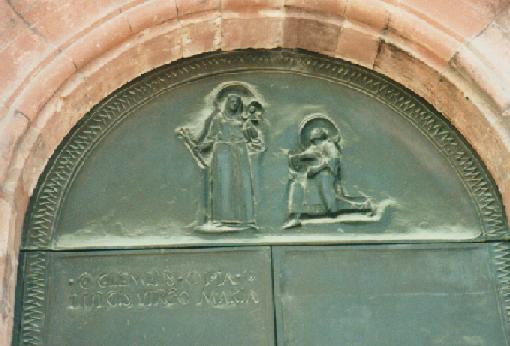
The Virgin and St. Bernard on the north door of the Cathedral of Speyer. (Source.)

A similar story is recorded about an apparition in the Cathedral of Speyer, when St. Bernard is said to have spontaneously uttered the words, “O Clemens, O Dulcis, O Pia” at the conclusion of the Salve Regina, thus giving the antiphon a new ending. Three circular mosaics in the Cathedral floor were installed at the place where St. Bernard was said to have knelt at each phrase. In one chronicler's variant of the Speyer story, St. Bernard rebukes the statue, saying that women should be silent in Church. It does sound like something he might have said.

Monday, August 20, 2012

St. Bernard of Clairvaux

The Virgin feeds St. Bernard from her breast.
Today is the Feast of St. Bernard of Clairvaux, one of the political and theological heavy-hitters of the Middle Ages, who counseled popes and kings and whose preaching and writing earned him the title of The Mellifluous Doctor. It is hard to know what to say of a saint so gifted and complex as St. Bernard, so I'll leave it to the older edition of the Cistercian Menology, where several other great saints of his era weigh in:
The feast of our very glorious Father St. Bernard, first Abbot of Clairvaux. Of noble birth, at the age of twenty-two, he succeeded in bringing to follow Christ thirty associates whom he led to Citeaux. In the Cloister his fasts, vigils and prayers were marvellous, and his life therein all heavenly. Soon, in spite of his youth, he was sent to Clairvaux. While assiduous about his own perfection, he labored zealously and successfully for the sanctification of those committed to his care. But circumstances compelled him to leave his solitude. He advises Popes, pacifices kings, converts the people, puts and end to the schism, crushes heresy, preaches the Crusades, refuses Bishoprics, works countless miracles, writes inestimable works, and when he dies at the age of 63, 160

Sunday, August 19, 2012

St. Bernard on Loving God


Tomorrow is the Feast of St. Bernard of Clairvaux, Doctor of the Church remembered as the Mellifluous Doctor and the Last of the Fathers.

The excerpt below is from his famous On Loving God, one of the greatest short works of the Middle Ages.

Love is a good and pleasant law; it is not only easy to bear, but it makes the laws of slaves and hirelings tolerable; not destroying but completing them; as the Lord saith: 'I am not come to destroy the law, but to fulfill' (Matt. 5:17). It tempers the fear of the slave, it regulates the desires of the hireling, it mitigates the severity of each. Love is never without fear, but it is godly fear. Love is never without desire, but it is lawful desire. So love perfects the law of service by infusing devotion; it perfects the law of wages by restraining covetousness. Devotion mixed with fear does not destroy it, but purges it. Then the burden of fear which was intolerable while it was only servile, becomes tolerable; and the fear itself remains ever pure and filial. For though we read: 'Perfect love casteth out fear' (I John 4:18), we understand by that the suffering which is never absent from servile fear, the cause being put for the effect, as often elsewhere. So, too, self-interest is restrained within due bounds when love supervenes; for then it rejects evil things altogether, prefers better things to those merely good, and cares for the good only on account of the better. In like manner, by God's grace, it will come about that man will love his body and all things pertaining to his body, for the sake of his soul. He will love his soul for God's sake; and he will love God for Himself alone.